Hurricane Sandy has hit the east coast of the USA. It had unprecedented energy and size, was a product of global warming. A spate of articles in its aftermath tell us why.
Its time for a brutal look at global carbon emission figures and their link to temperature rise, by Professor Kevin Anderson. He says that climate change is going beyond dangerous. We should expect to hit 4 degrees of warming given projections of the most optimistic current policies.
George Lakoff (https://www.commondreams.org/view/2012/10/30-8), who is always looking for the best words, calls it a systemic causation.
". . . Each day the amount of extra energy accumulating via the heating of the earth is the equivalent of 400,000 Hiroshima atomic bombs. . ."
". . . Global warming heated the water of the Gulf and Mexico and the Atlantic Ocean, resulting in greatly increased energy and water vapour in the air above the water. When that happens, extremely energetic and wet storms occur more frequently and ferociously. These systemic effects of global warming came together to produce the ferocity and magnitude of Hurricane Sandy. . . ."
The storm damages are estimated in tens of billions. New York Subways were flooded by storm surge sea water. Fortunately the storm has shutdown one of the centres of professional global warming denial, the New York Financial district. It also managed to cut electric power in very large areas, with entire cities going black.
Insurance companies will take big hits and will be putting up premiums. The recovery efforts will be an economic stimulus, and will create jobs and add to national GDP, more so than any recent US government economic stimulus effort. But this will likely not compensate for the businesses, homes, capital and jobs damaged or lost, lives lost, and the time taken for recovery. Australia sends sympathy and ought to know that there will be more to come, as nearly everyone will get their extreme weather turn.
This is only at less than 1 degree C of warming. Yearly carbon emissions continue to rise on top of our already massive amounts. Annual rate of atmosphere CO2 increase is 2 ppm per year over the last decade, and so the trend will pass 400 ppm by 2017. (http://co2now.org/Current-CO2/CO2-Trend/)
For global warming, the total amount of human added CO2 matters the most. Global human caused carbon emissions in 2010 were a record 9.1 GtC (33.5Gt CO2). To reach 2 degrees of certain global warming disaster, it is only necessary to continue emissions growth as usual to 2025. (http://grist.org/climate-change/2011-12-05-the-brutal-logic-of-climate-change/). That is only 12 years away. Because reductions take time, we could choose to start now and aim to reduce by 5% of current each year over approximately 20 years. Each year of failure to reduce carbon emissions adds to the intensity of the economic crash required to halt all additional emissions, to avoid exceeding the global carbon budget for 2 degrees.
Systemic global warming response includes unexpected surprises, such as accelerated arctic ice cap melting. More recent climate science finds that 2 degrees warming is likely to be unsafe. This will likely trigger further warming from many positive feed-backs, including arctic and tundra melting, decrease in ocean uptake of additional CO2, increased release of CO2 from dying forests, vegetation and soils around the world, as global living and physical systems respond dynamically to warming. Human emission reductions need to be sufficiently large to allow for positive feedback additions to CO2 release.
The carbon emissions budget for climate safety has a range of uncertainty, stretching towards the pessimistic. Given our current states of denial, it is likely that we have less time, and a much smaller emissions budget left, than our most optimistic and ignorant projections. Current best international proposals, policies and stated intentions, even if successful, have chosen a target of 2 degrees which at best separates consequences of "dangerous" from "extremely dangerous" climate change. The changes we expected at 2 degrees are expected now at 1 degrees of warming.
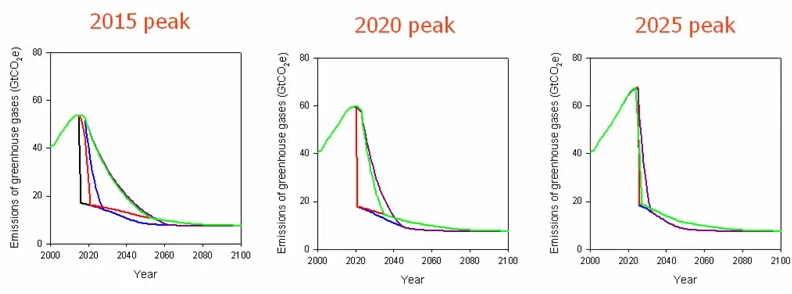
When do we stop growing CO2 emissions, and cut back for relative climate safety? Zero emissions cannot be achieved because 7 billion people need to eat.
Professor Kevin Anderson - former director of Tyndall Centre, University of Manchester, UK
Terrifying analysis and conclusions in this document: http://ianmcpherson.com/blog/audio/Kevin_Anderson_LSE_10-2011.pdf
The emissions numbers are crunched, and the broad conclusions are:
- 1 degree is the upper acceptable safe level of climate change. That target has gone, its far too late.
- We should be mitigating strongly for 2 degrees C, but to plan for and expect 4 degrees.
- Unfortunately policy seems to be that we are mitigating weakly for 4 degrees, while politicians sign up on pledges to keep warming below 2 degrees, but take little action.
- Government scientists, economists, and climate policy makers are being overly optimistic, and tend to massage their data, models and presentations, to show most optimistic results for political paymasters. No one wants to hear or pay for bad news.
- To allow for achievable emission peaks in non-annex-1 nations, such as China and India, developed nations need to be cutting emissions at unprecedented rates now, to keep below 4 degrees of warming.
- Serious mitigation efforts, to be successful, will need to start now with yearly emission reductions of 5% or greater, which are not compatible with economic prosperity, and will probably create hardship greater than that experienced in the economic collapse of the former Soviet Union, (5% per year), sustained for decades. Any politician promising shared prosperity and appropriate responses to climate change is promising the impossible. Shared hardship is much more likely. Sharing will be necessary to avoid terrible social conflict.
- Restriction to only 2 degrees of climate change warming is still possible but requires significant sustained human change.
Webinar Talk - Climate Change: going beyond dangerous. http://www.slideshare.net/slideshow/embed_code/8513442
Add Comment
This policy contains information about your privacy. By posting, you are declaring that you understand this policy:
This policy is subject to change at any time and without notice.
These terms and conditions contain rules about posting comments. By submitting a comment, you are declaring that you agree with these rules:
Failure to comply with these rules may result in being banned from submitting further comments.
These terms and conditions are subject to change at any time and without notice.
Comments